| Accordion
Billboard Home
Prominent
Accordionists
Accordion
Types
Accordion
Gallery
120 Bass Dallape
140 Bass Dallape
Petosa G (77)
Series
Accordion
Music
Accordion
Info
Who is
Playing
Accordion
Teachers
Accordion
Clubs
Accordion Videos
Events
Classified
Links
|
Categories of Accordions
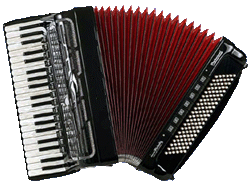
 Piano
Accordions - by far the most popular accordion in the United
States. As the name implies, there is a piano type keyboard
for the right hand. For the left hand there are a field of buttons
for the bass accompaniment. A full size accordion has 41 treble
keys and 120 buttons for the bass; some have 140 buttons.
The most common full piano keyboard ranges from a low "F" to a high
"A". There are other variations for the piano
keyboard. Also, many lesser configurations exist for the piano
accordion with fewer treble keys and fewer bass buttons.
Most commonly the bass buttons are arranged in a "stradella"
bass configuration; some accordions have a "free bass"
configuration for the bass buttons. Many young beginning
students start with a "12 Bass" accordion which, as the name
implies, has 12 bass buttons for left hand and a two octave
keyboard for the right hand.
Piano
Accordions - by far the most popular accordion in the United
States. As the name implies, there is a piano type keyboard
for the right hand. For the left hand there are a field of buttons
for the bass accompaniment. A full size accordion has 41 treble
keys and 120 buttons for the bass; some have 140 buttons.
The most common full piano keyboard ranges from a low "F" to a high
"A". There are other variations for the piano
keyboard. Also, many lesser configurations exist for the piano
accordion with fewer treble keys and fewer bass buttons.
Most commonly the bass buttons are arranged in a "stradella"
bass configuration; some accordions have a "free bass"
configuration for the bass buttons. Many young beginning
students start with a "12 Bass" accordion which, as the name
implies, has 12 bass buttons for left hand and a two octave
keyboard for the right hand.
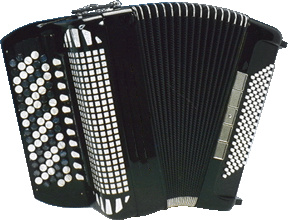
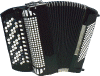 Chromatic
Accordions - very common in Europe but not very common in the United
States. These accordions have buttons for both the right hand
(treble side) and the left hand (bass side). The arrangement of
the bass buttons is similar to the arrangement for the bass buttons for
the piano accordion, i.e., either "stradella" or "free
bass". For the right hand the button configuration has either
3, 4, or 5 rows of buttons. Whereas the hand can span a little
over an octave for the piano keyboard, the hand can easily span more
than two octaves for the chromatic accordion. For the 5 row
instrument, there is an advantage in that the same fingering may be used
as music is transposed to various keys. Two of the more popular
arrangements for the treble buttons is the "B Grif" and C
"Grif". The "B Grif" configuration is better
suited for classical music, whereas the "C Grif" configuration
is better suited for playing chords.
Chromatic
Accordions - very common in Europe but not very common in the United
States. These accordions have buttons for both the right hand
(treble side) and the left hand (bass side). The arrangement of
the bass buttons is similar to the arrangement for the bass buttons for
the piano accordion, i.e., either "stradella" or "free
bass". For the right hand the button configuration has either
3, 4, or 5 rows of buttons. Whereas the hand can span a little
over an octave for the piano keyboard, the hand can easily span more
than two octaves for the chromatic accordion. For the 5 row
instrument, there is an advantage in that the same fingering may be used
as music is transposed to various keys. Two of the more popular
arrangements for the treble buttons is the "B Grif" and C
"Grif". The "B Grif" configuration is better
suited for classical music, whereas the "C Grif" configuration
is better suited for playing chords.
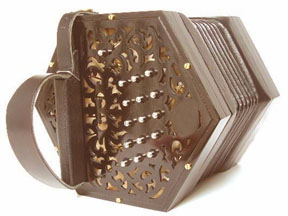
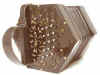 Concertinas
- whereas the piano accordion and chromatic accordions have straps to
fasten the accordion to the player, the concertina is held and played
with two hands. The concertina has buttons for both the
right and left hands. There are many variations of the
concertina. For more detail go to: Widipedia - Concertina
For additional information go to: concertina.com/
Concertinas
- whereas the piano accordion and chromatic accordions have straps to
fasten the accordion to the player, the concertina is held and played
with two hands. The concertina has buttons for both the
right and left hands. There are many variations of the
concertina. For more detail go to: Widipedia - Concertina
For additional information go to: concertina.com/
Diatonic
Accordions - there are many variations of the diatonic
accordion. Generally there are buttons for the left hand and for
the right hand. The significant distinction for the diatonic
accordion is that for a single key the pitch of the note changes as the
bellows is pushed or pulled. More information on diatonic
accordions at: Accordion
Heaven
More accordion information at: Wikipedia-
accordions, Accordion
Heaven
Some Accordion Manufacturers/ Makes
Armando Bugari -
Arpeggio
Beltuna
Bell
Bugari
Castiglione established in 1932,
by Vincent Castiglione after he immigrated from Italy. The
Castiglione company customizes, repairs, sells and distributes
accordions.
Owner: John Castiglione. Located at 13300 E 11 Mile,
Suite A. Warren, MI 48089-1367
Telephone: (800) 325-1832 or (586) 755-6050
More Info
Cellini
Colombo
Cordovox
Crucianelli
Dallape
Diamond
Excelsior
Fisart
Gabbanelli
Guerrini
Giulietti
Hohner
Iorio
La Melodiosa
LoDucca
Moreschi
Pancordion
Paolo Soprani - started
production in 1863 in Castelfidardo, Italy More
Info
Philharmonic
Petosa - More
Info
Pigini - On
6th June 1946 Filippo Pigini registered the company "F.lli PIGINI
di filippo" at the Chamber of Commerce in Ancona, Italy. The first
deliveries made in the USA, Canada, Sweden, Denmark, Argentina, Egypt
and Pakistan showed PIGINI's international spirit right from the start.
The company was run for many years by Gino Pigini, who, at the age of 14
was already an expert "vociarolo" (reed maker). He believed in
young people with new ides and the desire to learn. He soon formed a
team of exceptioinal craftsmen and even today his work and philosophy
lie behind PIGINI's top quality products. Pigini
manufacturing is located in Castelfidardo, Italy
More
Info
Sano
Scandalli - Located in
Castelfidardo, Italy, began production in 1926. Received patents
for various innovations. More
Info
Sonola
Soprani
Stradovox
Titano
Universal
Vignoni
Weltmeister
Zero Sette
History of the Accordion
For an interesting history of the
accordion click Petosa
|